

Resource-aware processing
Required fonts, overlays, forms, code pages, and production resources are evaluated as part of the environment.
Enterprise legacy document accessibility
Braillia adds an accessible information path around established systems, turning critical statements, notices, forms, correspondence, and archives into information blind and low-vision people can independently read, understand, and act on.
Resource-aware processing recipient-boundary protection multiple accessible outcomes evidence-ready operations
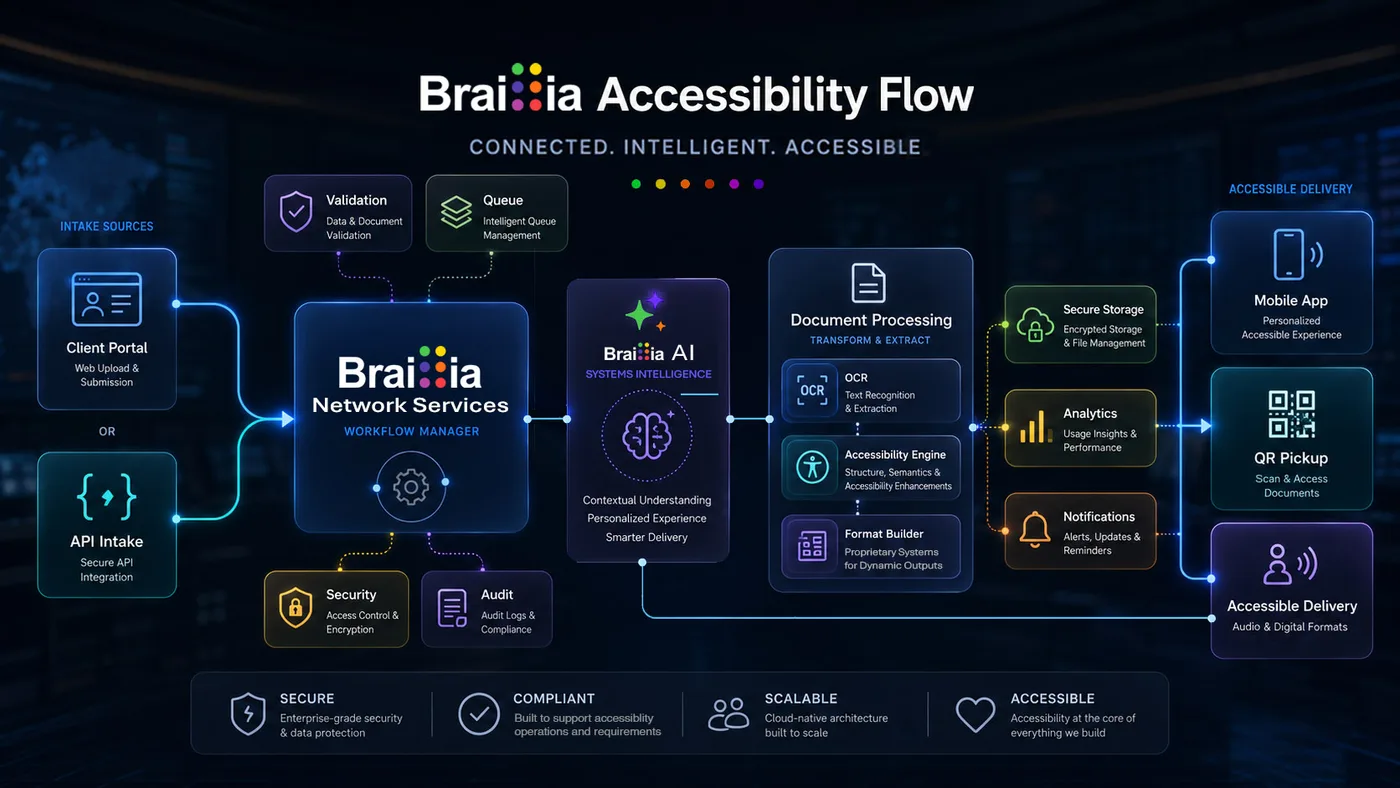
Keep your systems. Transform the experience.
Critical customer communications still come from mainframes, composition platforms, print archives, and production workflows built long before digital accessibility became a requirement. Braillia creates a practical accessibility path around these established systems while a broader modernization strategy moves at the pace the organization requires.
A visually accurate document can still fail the person receiving it: reading order can collapse, tables and forms can lose their meaning, instructions can be missed, and one customer's data can be mixed into another person's experience. Braillia creates a practical path between your existing infrastructure and the accessible experience people need.
Beyond conversion
The value is in preserving the information and relationships a person needs to use correctly: text, reading order, headings, lists, tables, forms, links, graphics, page geometry, document boundaries, recipient boundaries, and the production resources that make the communication complete.
Required fonts, overlays, forms, code pages, and production resources are evaluated as part of the environment.
Transactional communications are designed to preserve the separation between one recipient's information and another's.
One prepared source can support outputs, secure delivery, guided mobile access, and interactive assistance where the workflow calls for it.
Implementation decisions, validation results, exceptions, and delivery evidence remain connected to the document workflow.
A verified implementation profile for your environment
Braillia treats each critical legacy communication as a source-specific implementation shaped around the organization's environment, resources, document families, recipient boundaries, accessible outputs, delivery expectations, and acceptance criteria.
Review source systems, document families, production resources, delivery needs, and security requirements.
Identify the reading order, data relationships, tables, forms, document boundaries, and recipient boundaries that independent use depends on.
Configure the document profile, accessible outputs, integration approach, and delivery experience for the specific workflow.
Confirm the agreed acceptance criteria, manage exceptions, and maintain the evidence needed to keep the workflow dependable.
Legacy document environments
Braillia begins with a format and workflow assessment, then confirms the implementation profile, resource requirements, accessible outputs, and acceptance criteria needed for that communication family. Unknown commands, incomplete resources, damaged structures, and unsupported behavior become explicit exceptions for controlled resolution, preserving the reliability of the accessible output.
AFP and MO:DCA families, IBM line data and EBCDIC sources, PCL, PostScript, XPS, PRN streams, production spool environments, and variable-data communications.
Xerox LCDS and Metacode environments, VIPP, PDF/VT, PPML, and the resources, templates, and recipient data that make high-volume documents work.
PDF, office files, email, HTML, XML, JSON, CSV, and other records that carry customer communications, forms, instructions, and operational information.
Scanned records, fax and image collections, multipage TIFF workflows, and archives that need a usable path forward rather than another inaccessible repository.
One prepared source, usable access paths
The same prepared information can serve independent accessible outputs, secure organizational delivery, and guided interaction, giving people a dependable experience they can return to.
HTML, EPUB, eBraille, TXT, and accessible PDF where appropriate for the communication and recipient.
Organization-controlled direct delivery, QR pickup, portal access, API workflows, and downloadable formats.
Braillia Mobile and interactive document support when a person needs help navigating, understanding, or acting on the information.
Security and trusted operations
Braillia's implementation approach accounts for protected inputs, tenant separation, controlled resource resolution, and the operational limits appropriate to the workflow.
Source materials, implementation decisions, validation results, warnings, outputs, and delivery records can remain connected across the lifecycle of the communication.
The objective is a dependable experience that preserves the document's meaning and helps the person understand the information and take the next step independently.
Bring Braillia one high-consequence document environment. Together, we can define the access path that protects your workflow while giving people information they can independently use.