

One source becomes usable information
Braillia reconstructs the structure and relationships people and assistive technology need.
Braillia document transformation
Follow the Braillia path from source intake and semantic reconstruction to independent accessible files, verification evidence, and optional guided delivery through Braillia Mobile.
Guided product proof using current Braillia captures and clearly labeled representative scenes. No customer information is shown.
Braillia reconstructs the structure and relationships people and assistive technology need.
HTML, EPUB, eBraille, TXT, and accessible PDF can support familiar systems and technology.
Secure delivery, mobile reading, Braillia AI, reminders, and action support extend the experience.
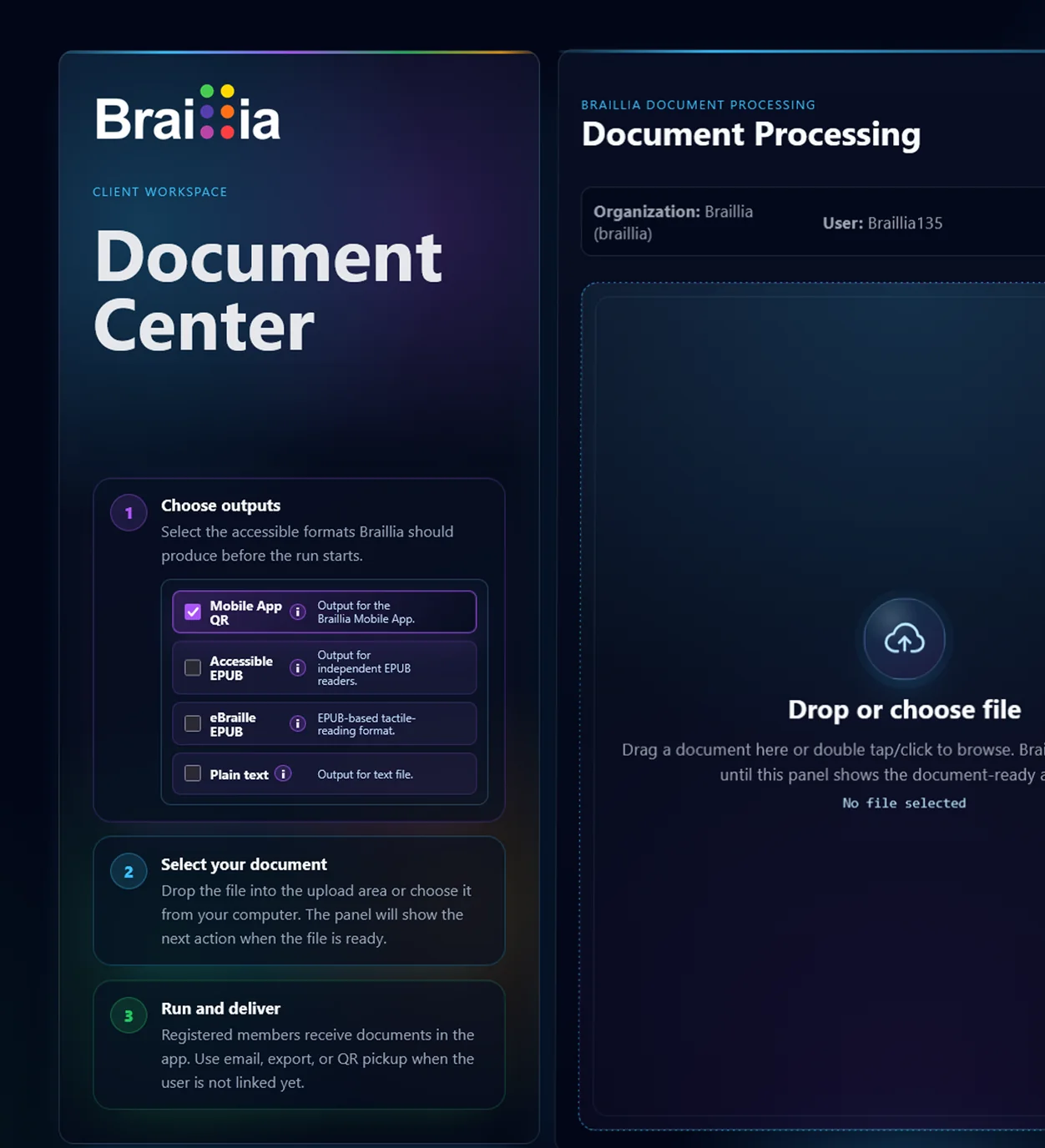
Guided product walkthrough
Move through the real Braillia workflow at your own pace. Product captures show current interfaces and states; representative scenes are labeled clearly and contain no customer information.
01 / Intake
Braillia begins with the source file, the formats the organization needs, and the way the information must reach the person. The workflow is shaped around the access outcome before processing begins.
Human outcome: The organization defines usable access before the document enters processing.
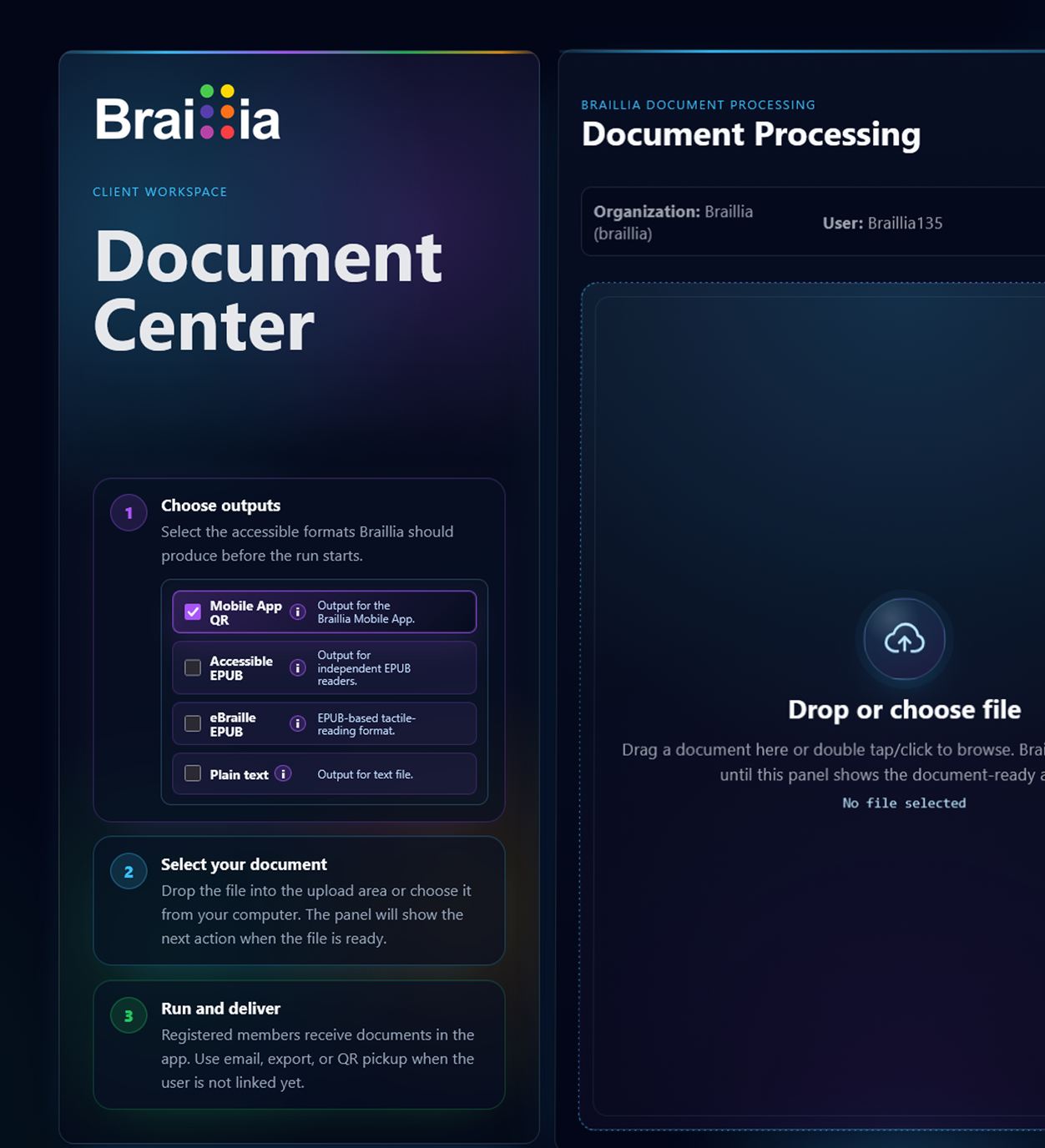
Use your own source
Define the required formats, access path, security boundaries, and evidence your organization needs to evaluate.
What changes for the person
The value is measured in what the person can do after the transformation, and in what the organization can verify and improve across the workflow.
Where access breaks
A screen reader encounters weak or missing structure
What Braillia changes
Reconstruct headings, sequence, labels, and meaningful relationships
What becomes possible
The person can navigate the information with greater independence
Where access breaks
Tables, forms, amounts, or instructions lose their context
What Braillia changes
Preserve the relationships that explain what each value or action means
What becomes possible
The person can understand the information and identify the next step
Where access breaks
One fixed file cannot serve every access path
What Braillia changes
Create multiple accessible outputs from one prepared source
What becomes possible
People can choose a format that works with the technology they use
Where access breaks
Time-sensitive information still needs delivery and support
What Braillia changes
Connect the prepared source to direct delivery, QR setup, mobile guidance, and AI assistance
What becomes possible
The person can receive, question, understand, and act while the information still matters
One prepared source
HTML, EPUB, eBraille, TXT, and accessible PDF can work across familiar systems, devices, and assistive technology.
Secure delivery, QR setup, voice-guided reading, Braillia AI, reminders, and action support extend the prepared information.
Start with real information
We'll define the transformation, formats, access path, and evidence your organization needs to evaluate.