

Source-to-fact anchoring
Critical facts remain tied to source locations, giving users and systems source-grounded context they can verify.
Braillia Document Processing
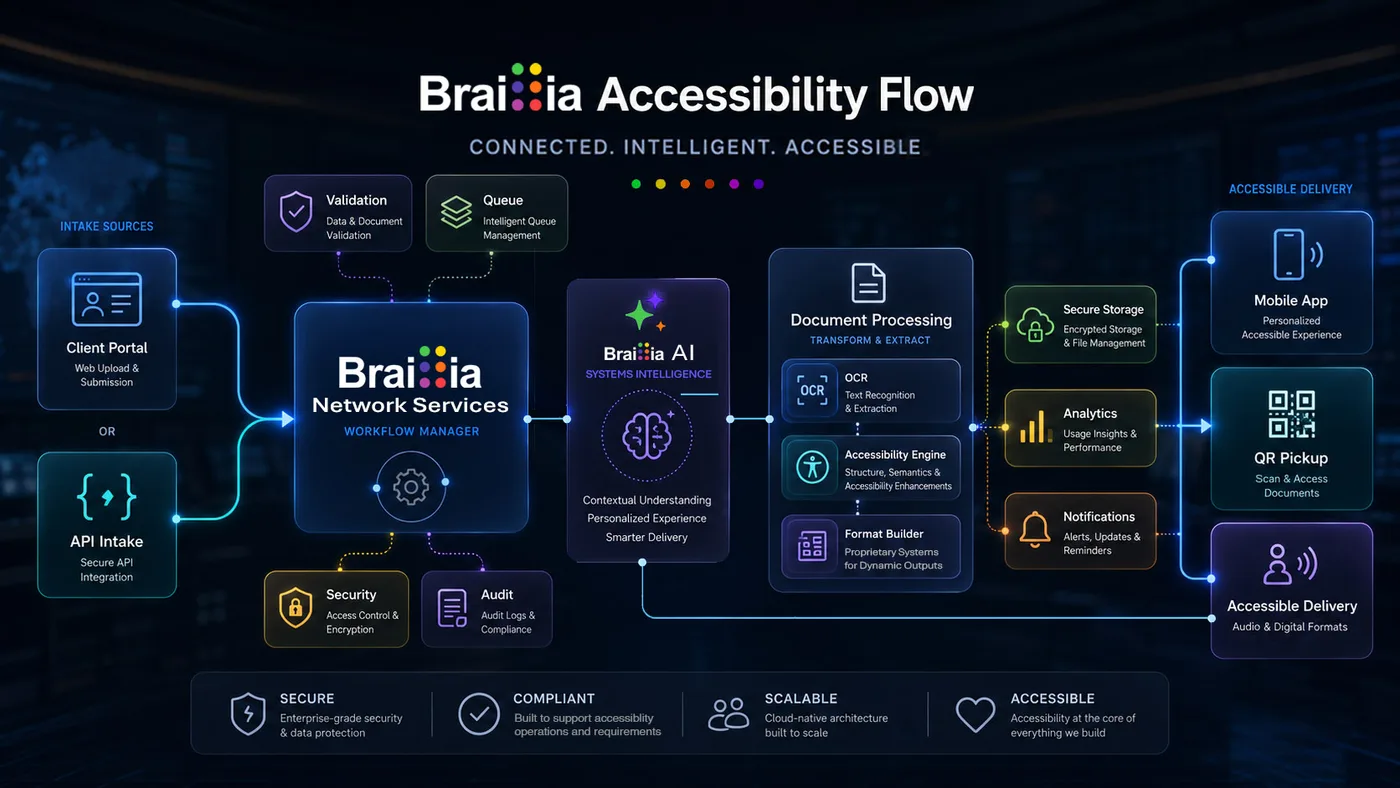
When a statement, notice, form, instruction, or packet is difficult to navigate, people can miss the information and action it requires. Braillia reconstructs critical source material into structured accessible outputs that work with people’s preferred technology, then connects it to secure delivery and guided support when more is needed.
Document processing
What makes the difference
It has to be understandable, navigable, and usable with the technology a person already relies on. Braillia prepares a structured information package around the source so the same content can support independent use, organization delivery, and trustworthy assistance.
See the Connected PlatformStart with the document
Accessible information package
The work that matters
Critical information has relationships that people need to understand correctly: labels, values, headers, rows, totals, instructions, deadlines, and required actions. Braillia keeps those relationships connected to accessible output and the source they came from.
Critical facts remain tied to source locations, giving users and systems source-grounded context they can verify.
Braillia focuses on the relationships that often break access: labels, values, headers, rows, totals, instructions, and required actions.
Teams need more than an output file. Braillia records transformation, remediation status, technical mappings, and review evidence.
AI assistance stays grounded in the document package, identifies uncertainty, and reports when a requested fact is absent.
One prepared source, multiple access paths
Accessible output stands on its own for people and their assistive technology. Braillia Mobile, secure delivery, organizational systems, and grounded assistance extend that same prepared information when the workflow calls for more.
Mobile and web experiences users can hear, navigate, question, save, and act on.
Cleaner structure for screen readers and operating-system accessibility tools.
Governed issuance through portals, APIs, customer communication systems, and delivery workflows.
Source-grounded context for answers, cited evidence, uncertainty, and not-found responses.
A governed record of transformation, validation, delivery path, and accessibility work that can be improved over time.
The Braillia difference
Remediation and document processing create the usable source. The Portal and APIs support controlled delivery. The embedded web app and mobile app help people interact with it. Braillia AI can provide grounded assistance when it's enabled for the workflow.
Buyer questions
Braillia helps organizations assess barriers, remediate critical information, deliver usable access, and scale the operating model around it.
Braillia uses standards-based outputs rather than requiring a proprietary extension. Document Processing can provide HTML, EPUB, eBraille, TXT, and accessible PDF when appropriate, along with semantic metadata, source anchors, validation evidence, and AI context.
Braillia Mobile serves as the reference reader and high-assurance user experience. The verified accessible information layer also supports embedded website access, assistive technology, enterprise workflows, and AI.
Braillia produces verifiably accessible digital documents that conform to applicable technical accessibility standards and include auditable evidence of transformation, validation, and delivery. Legal determinations depend on the full content, timing, policies, access path, and organizational context.
AI can read many files, but inaccessible source structure can cause important facts, labels, tables, instructions, or deadlines to be missed or misunderstood. Braillia prepares source-grounded context so AI can answer from verified structure and identify uncertainty.
Show us where people are being blocked. Braillia will define the remediation, delivery, and guided access path your team can evaluate.